Freelance Designer Tax Guide: Client Revisions, Software Costs, and Cash Reserves for Irregular Creative Work

Freelance design work can look profitable right up until you measure the hours correctly. A brand project gets approved, then turns into three extra rounds of revisions. A website mockup leads to new file exports, format changes, and "small tweaks" that quietly eat another week. Meanwhile the business keeps paying for Adobe, Figma, fonts, stock assets, cloud storage, and a laptop replacement cycle that never feels optional. Designers do not usually get in trouble because they are bad at math. They get in trouble because creative work hides margin erosion in places that invoicing alone does not show.
That is why a design tax system has to do more than collect receipts. It needs to separate true income from underpriced labor, keep software and asset costs visible, and protect cash during months when client work slows down or payment timing gets weird.
Revision-heavy work changes the economics of a project
Revisions are not just a workflow issue
For freelance designers, revisions affect taxes indirectly by affecting profit. If a project was quoted as a solid-margin engagement but the actual hours doubled because the scope stayed loose, the tax problem shows up later. You may feel flush because the invoice total looked decent, but your effective hourly rate collapsed and the after-tax profit is much thinner than expected.
That matters because self-employed tax planning works better when pricing and bookkeeping tell the same story. If your records show strong revenue but your actual capacity is being drained by endless revision work, your reserve targets, quarterly estimates, and spending decisions can all drift out of sync with reality.
Track revision-heavy projects as a separate pattern
You do not need a complex analytics dashboard. You do need enough visibility to identify when revision scope is crushing margin. A practical setup is to tag projects internally as one of three types:
- Clean delivery with minimal revisions
- Normal revision load
- Revision-heavy or scope-creep prone work
This is not for the IRS. It is for you. When several projects keep landing in that third category, the tax lesson is not merely "save receipts." It is "your pricing and contract structure may be understating the labor that creates your taxable income."
Software and digital tools are real business costs
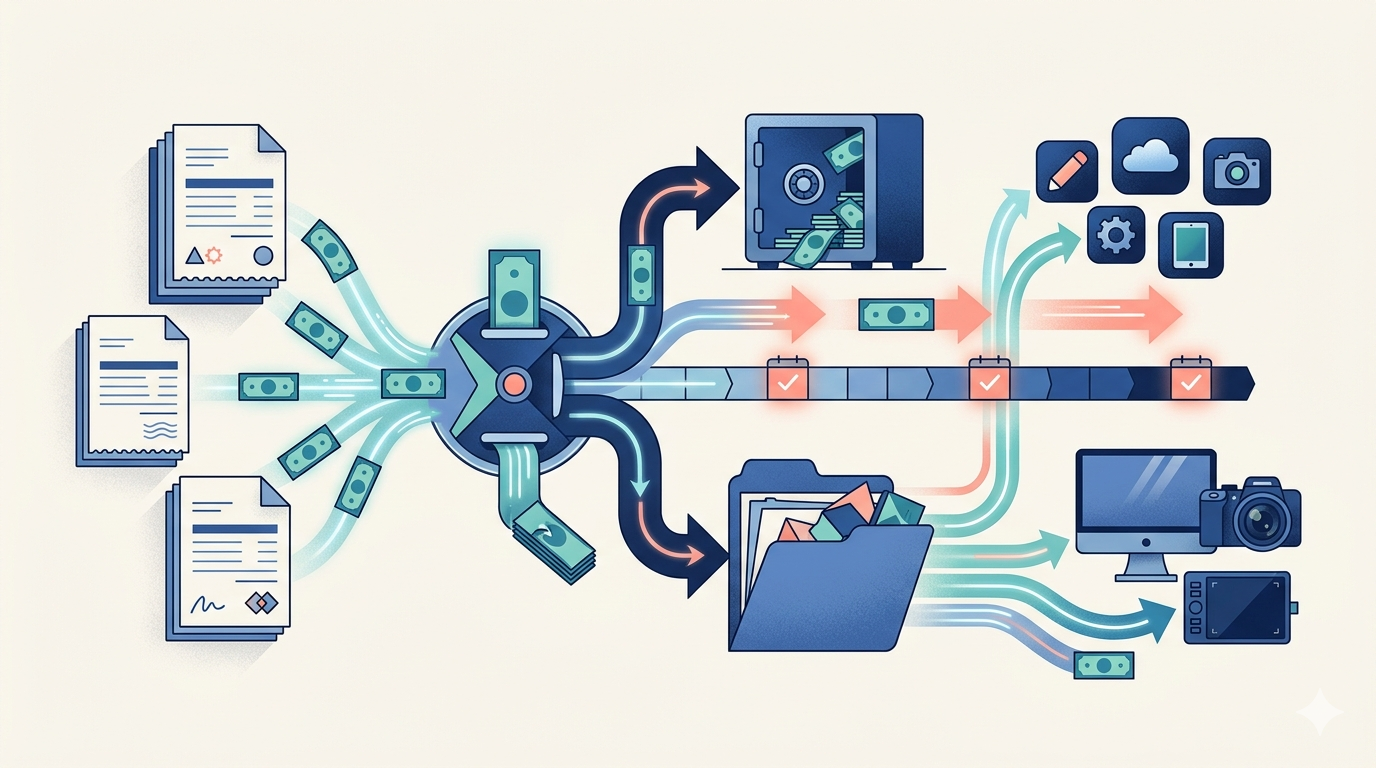
Designers often have expense stacks that look lightweight compared with product businesses, but they add up fast. Monthly software subscriptions, paid plugins, prototyping tools, stock libraries, typefaces, website hosting, cloud storage, portfolio platforms, and communication tools can create a significant recurring burn rate.
The key is to categorize these costs cleanly instead of burying everything in a vague "software" bucket. Separate records make year-end review easier and help you decide what is actually worth keeping.
Common expense buckets worth separating
A sensible chart of categories for many freelance designers includes:
- Design software and creative subscriptions
- Stock assets, fonts, templates, and licensed media
- Web hosting, domains, and portfolio tools
- Hardware and peripherals
- Education, courses, and conferences
- Marketing and lead generation
- Contractor or specialist support such as copy, development, or illustration
This kind of structure does two jobs at once. It supports cleaner tax prep, and it shows which tools are helping the business versus quietly draining cash every month.
Be conservative with mixed-use purchases
Design businesses often run through devices and software that also touch personal life. That does not mean nothing is deductible. It means you need a reasonable, documented business basis. If a subscription, tablet, phone plan, or home internet bill serves both personal and business use, sloppy overclaiming is a bad trade. Clean partial allocation is usually the stronger move.
The standard is not whether you can invent a business angle for a purchase. It is whether the cost is ordinary and necessary for the work you actually do, and whether your records make that conclusion feel straightforward.
Cash reserves matter more in creative work than many designers admit
Freelance design income is rarely smooth. One month brings a large brand package and a rush of deposits. The next month is mostly proposal writing, unpaid discovery, or waiting for feedback. That volatility is exactly why designers need two distinct reserve habits: a tax reserve and an operating reserve.
A lot of self-employed people combine those in their head and call it savings. That is how a healthy bank balance becomes misleading.
Your tax reserve is not emergency money
A tax reserve exists because part of every client payment was never really yours to spend freely. Federal income tax and self-employment tax do not care that a client paid late last month or that another project is stuck in revisions. If the cash stays in your main account, it starts to feel available. That is the trap.
A practical rule is to move a fixed percentage of every payment into a separate tax savings account as soon as the money clears. The exact percentage depends on your overall income, state taxes, filing status, and other factors, but the habit matters more than the perfect number on day one.
Your operating reserve protects irregular creative work
The second reserve is for the business itself. Designers often experience lumpy work cycles, extended approvals, project pauses, and clients who vanish between rounds. An operating reserve gives you room to keep paying subscriptions, contractors, and normal business bills without treating every slow month like a crisis.
For many freelancers, the most useful target is not abstract. It is a concrete number based on one to three months of core business expenses plus a buffer for owner pay. Even a modest reserve changes decision quality. You stop overreacting to one delayed invoice. You also become less tempted to accept bad-fit projects just to refill the account.
Cleaner invoicing reduces tax-season confusion
Designers frequently mix several kinds of charges on the same project: concept work, production work, revision rounds, rush fees, reimbursed stock purchases, printing coordination, and pass-through contractor costs. That may be normal from a client-service perspective, but the accounting should still distinguish what happened.
Separate revenue from reimbursements and pass-through spend
If you buy a stock image, type license, or printing sample on a client’s behalf and then invoice it back, keep that traceable. The point is not to turn every invoice into a legal memo. The point is to avoid a year-end pile of charges that makes your margins impossible to read.
The same goes for subcontracted help. If a developer, illustrator, animator, or production assistant helped deliver the work, that should be visible in your books as contract labor or a similar category, not hidden inside a generic expense line.
Quarterly taxes get easier when you stop using your checking account as a decision tool
Freelance designers are especially vulnerable to "bank balance thinking." A big deposit lands after a slow month and instantly creates relief. Then software renewals hit, a contractor invoice comes due, and estimated taxes are suddenly close. The balance looked strong, but it was carrying too many jobs at once.
A better system is simple:
- Move a set percentage of every payment to tax reserves immediately.
- Review income and deductible expenses monthly, not only at quarter-end.
- Compare current cash against upcoming obligations, not against wishful optimism.
- Notice which clients or project types create the most revision drag and cash-flow instability.
That last point matters. Tax stress is often partly a pricing problem, partly a process problem, and only partly a tax problem.
The goal is a design business with visible margins
A good freelance designer tax system should let you answer basic questions quickly. What did you actually earn? Which software and asset costs were necessary? How much work became less profitable because revision scope stayed loose? What cash is reserved for taxes, and what cash is truly available to run the business?
If those answers are blurry, the fix is usually not more hustle. It is cleaner categorization, better invoice structure, and a disciplined reserve habit. Designers do their best work when they can focus. A finance system that exposes revision drag, controls software sprawl, and protects cash during uneven months buys that focus back.